Mary's compelled submission document
The King's CurseMary's compelled submission document was the instrument Henry VIII used to demand that Princess Mary Tudor accept his supremacy over the Church and deny the validity of her parents’ marriage. Its three clauses required her to affirm her father’s kingship and laws, recognize him as head of the Church of England, and declare her parents’ marriage unlawful. Her signature did more than register compliance: it made her publicly acknowledge the status the king imposed on her, as Lady Mary rather than a princess and as illegitimate.
Political and Legal Background
The document emerged from a conflict in which royal authority, church jurisdiction, marriage law, and succession were being made to support rival claims. Katherine of Aragon maintained that her marriage to Henry VIII had been consummated, while Margaret Pole had been ordered to testify that Prince Arthur and Katherine had been together. Margaret confirmed that the king’s instructions had been carried out, but refused to affirm that she knew the marriage had been consummated. Henry’s mother treated that distinction as a threat to her son and his dynasty, insisting that a papal dispensation could permit Henry to marry Katherine if Katherine’s account of the marriage prevailed. The dispute over the marriage therefore bore directly on the legitimacy of Henry’s later marriage and the status of the children born from it.
The larger institutional struggle had already altered the terms in which such claims could be made. When the Church surrendered to the king, Lord Montague told Princess Mary Tudor that Henry would rule the Church himself and that the Pope would be disregarded in England. Thomas More resigned as Lord Chancellor and returned the seal of office. Mary understood the change as the king taking the Church’s wealth, laws, and courts into his own possession. The document belonged to this new arrangement: a contested religious and marital judgment was presented not as an open question but as a matter the king could settle and require his subjects to affirm.
That demand followed an earlier oath imposed on the nobility. At Westminster Palace in the spring of 1534, Thomas Cromwell summoned peers to swear to the succession settlement. The narrator notes that the Pope had publicly ruled Henry’s marriage to Katherine valid, even as Henry claimed that the Pope had no authority in England. The oath confronted its recipients with the choice of how to act amid incompatible claims of authority. Mary's compelled submission document applied the pressure more personally: it required the king’s daughter to endorse the account of marriage and succession on which her own status depended.
Preparation and Threat
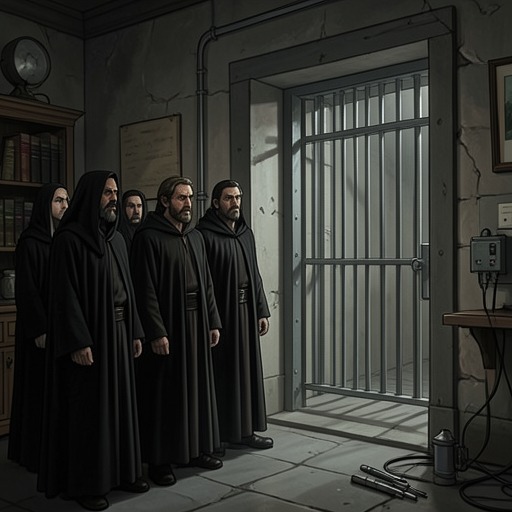
A panel of judges was convened to investigate Mary’s disobedience to the king. Although the judges briefly struggled with their consciences, they prepared the document and sent it to her at Hunsdon, where she was being held as a prisoner. She was told to sign or face a treason charge, a capital offense. The threat was sharpened by the presence of six men held in the Tower of London on suspicion of trying to rescue her; their lives, too, depended on what she did.
Mary was isolated from her friends and had no practical means of rescue. Her mother had been dead for less than a year, and Mary believed that her father might have her put to death if she refused. She also believed that her mother had been poisoned by Henry’s wife. The document thus arrived not as a request for a considered legal opinion, but as a demand backed by confinement, a death penalty, and danger to others. Its formal clauses gave institutional shape to pressure whose consequences were immediate and personal.
The Three Clauses and the Signature
The first clause required Mary to recognize Henry as King of England and to obey his laws. The second required her to acknowledge him as supreme head on earth of the Church of England. Together, these clauses demanded acceptance of both royal government and the king’s newly asserted ecclesiastical authority. They also displaced the Pope’s authority within England, the very issue that had prompted More’s resignation and Mary’s earlier alarm.
The third clause required Mary to recognize her parents’ marriage as unlawful under both divine and human law. That statement directly contradicted the Pope’s public ruling that the marriage was valid, as described in the account of the 1534 oath. It also struck at the basis of Mary’s identity and inheritance: if her parents’ marriage was invalid, she could no longer claim the standing of a legitimate princess. The document therefore joined a declaration of royal supremacy to a forced repudiation of her mother’s marriage and of Mary’s own legitimacy.
Mary signed all three clauses. The narrator records the cost of making her swear to the judgment against her mother, then reports the consequences: Mary accepted the title Lady Mary, rather than princess, and acknowledged that she was illegitimate. The signature supplied the king with her formal assent, but its circumstances expose the difference between agreement and submission. A declaration written in the language of recognition was obtained through the threat of prosecution and the lives of people already imprisoned.
Significance and Consequences
The document condensed a dynastic crisis into a personal act of compelled speech. Henry’s authority was asserted through a daughter required to deny the marriage that secured her place in the succession; the same instrument bound religious allegiance, obedience to the monarch, and acceptance of a revised family history. In this sense, it did not merely announce a new legal position. It demanded that Mary participate in giving that position the appearance of her own acknowledgment.
The episode also echoes the earlier pressure on Margaret Pole to testify about Katherine and Prince Arthur. In both cases, a woman close to the disputed marriage was asked to affirm a version of events with consequences for the Tudor succession. Margaret would not say more than she knew; Mary, facing a direct threat and the peril of her would-be rescuers, signed the prescribed clauses. Set beside Thomas More’s refusal to sign the succession oath exactly as written, Mary's compelled submission document shows how the same political settlement could elicit refusal from one person and coerced compliance from another. Its force lies in the gap between what the signature declares and the circumstances under which it was secured.